For years, LCD has been the dominant technology in commercial display applications—from retail signage to corporate meeting rooms.
However, this long-standing assumption is being fundamentally challenged.
A growing number of enterprises are now adopting fine-pitch LED displays powered by COB (Chip-on-Board) and MIP (Micro LED in Package) technologies. This shift is not driven by brightness improvements, but by advances in visual consistency, structural design, and long-term operational value.
Key insight: The display market is shifting from “functional adequacy” to “premium visual experience.”
What Are COB and MIP?
COB (Chip-on-Board)
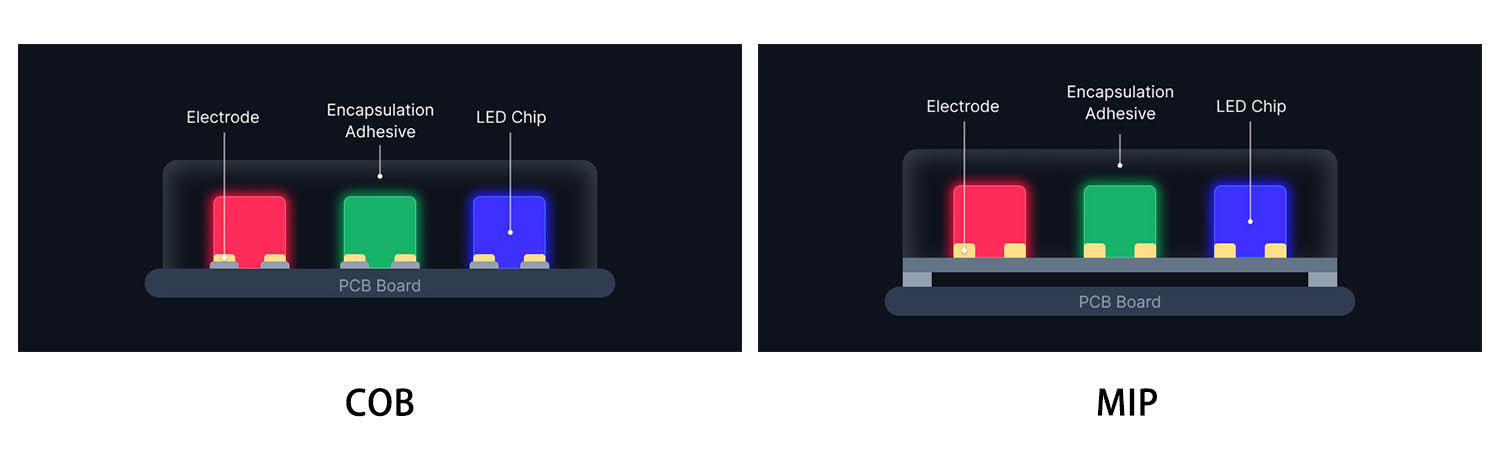
COB is a packaging technology where LED chips are directly mounted onto a PCB and encapsulated into a continuous surface layer.
Key characteristics:
- Fully integrated surface structure
- Improved impact and dust resistance
- Superior black consistency and uniformity
- High flatness suitable for seamless large displays
COB is widely used in large-format, high-end LED installations such as control rooms and corporate display walls.
MIP (Micro LED in Package)
MIP refers to a micro-packaging approach where ultra-small LED chips are first encapsulated into standardized units before being assembled into LED displays.
Key characteristics:
- Supports ultra-fine pixel pitches (P0.9, P0.7 and below)
- Higher manufacturing yield and consistency
- Better scalability for mass production of fine-pitch displays
Industry note: MIP is often considered either a sub-category or an evolution of advanced LED packaging technologies, with its core advantage being scalable ultra-fine pitch production.
Why Traditional LED Could Not Replace LCD
Before COB and MIP matured, LED technology faced clear limitations in indoor and high-precision environments:
- Large pixel pitch (typically P2.5 and above) caused visible pixelation at close viewing distances
- Exposed pixel structures reduced image smoothness
- Module gaps and surface inconsistency affected visual quality
As a result, LCD remained the preferred solution for indoor applications requiring close viewing and high image fidelity.
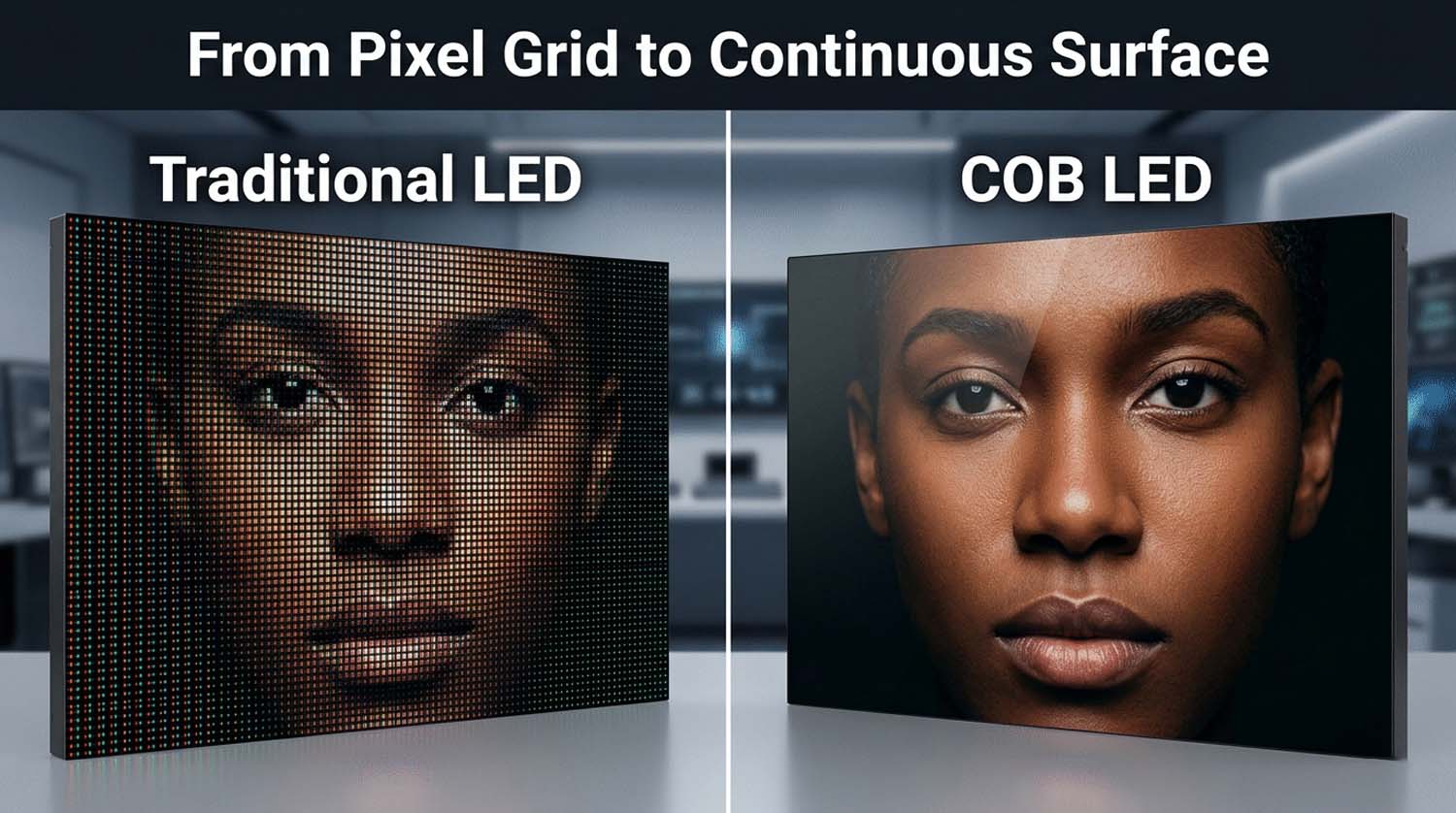
From Pixel Grid to Continuous Visual Surface
COB technology fundamentally changes how LED displays are perceived.
Instead of visible pixel grids, COB creates a continuous, unified surface.
Key improvements:
- Surface flatness deviation ≤0.1mm
- Black level as low as ≤0.01 cd/m²
- Significant reduction in visual noise and brightness inconsistency
Result: LED is no longer perceived as individual light points, but as a seamless visual canvas.
From Long Distance to Close-Range Precision
MIP technology pushes LED into ultra-fine pixel pitch ranges such as P0.9 and P0.7.
This enables:
- Comfortable viewing distances below 1 meter
- Native 4K/8K resolution on large LED surfaces
- Entry into traditional LCD-dominated environments
LCD vs COB vs MIP
| Feature | LCD | COB LED | MIP LED |
| Seamless Display | No | Yes | Yes |
| Close Viewing Comfort | Good | Very Good | Excellent |
| Contrast Performance | Medium | High | High |
| Structural Flexibility | Low | High | High |
| Maintenance Efficiency | Medium | High | High |
| Lifespan | ~50,000 hours | ~100,000 hours | ~100,000 hours |
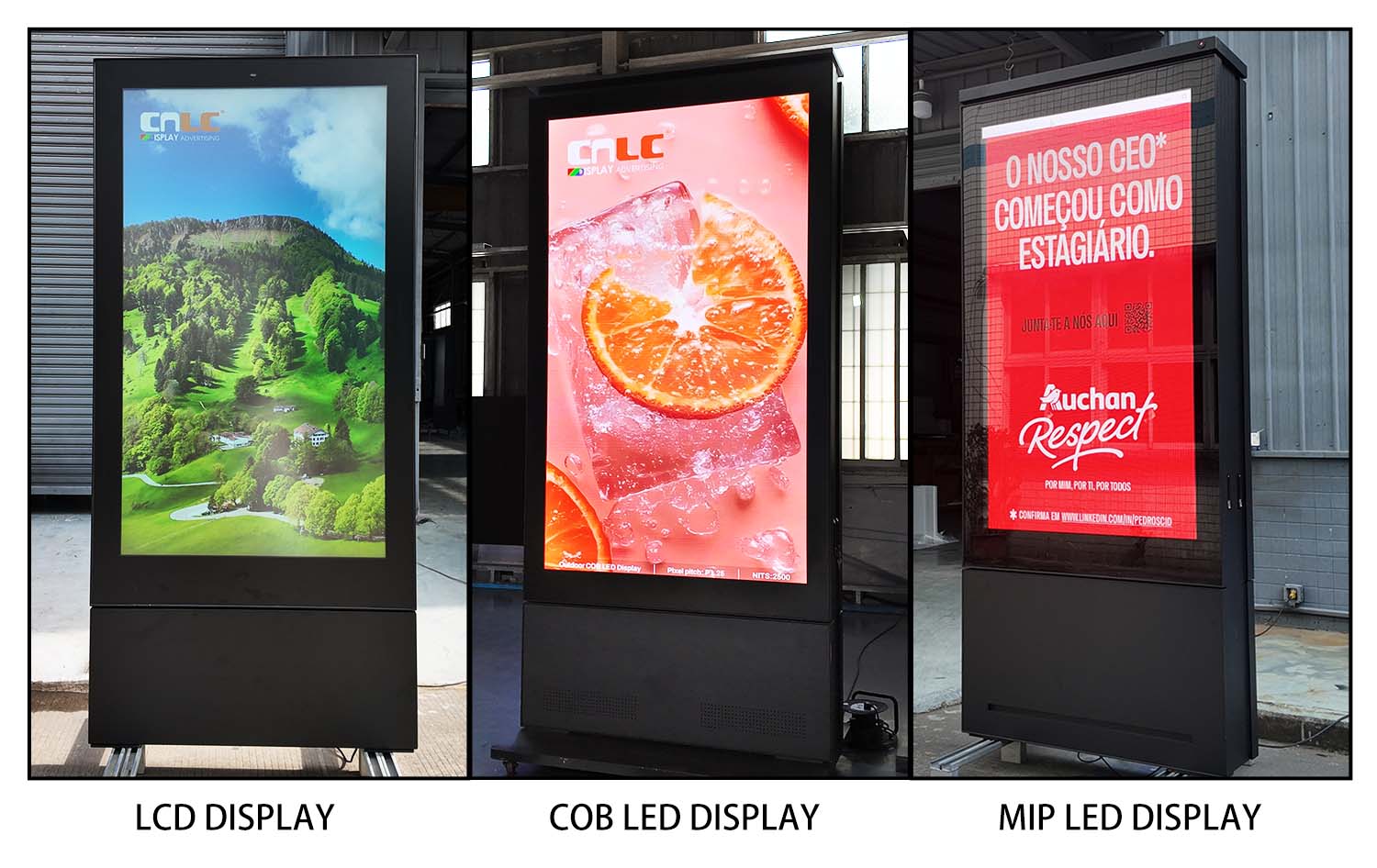
Key takeaway: COB enhances surface integrity, while MIP extends resolution and application scope.
Why COB and MIP Are Disrupting the LCD Market
The shift is not driven by a single parameter, but by multiple structural advantages.
1. Visual Continuity
LCD video walls always contain physical seams, even with ultra-narrow bezels.
LED displays eliminate this limitation entirely.
In premium environments, seamless visuals are now a baseline expectation.

2. Design Flexibility and Scalability
LCD is constrained by fixed panel sizes (55”, 65”, 86”).
LED can be customized into:
- Large-format video walls
- Curved or cylindrical displays
- Architectural integrations
This transforms displays from hardware into spatial design elements.
3. Long-Term Value and Maintenance Efficiency
Decision-making is increasingly based on total cost of ownership (TCO), not initial cost.
Key comparisons:
- LED lifespan: ~100,000 hours
- LCD lifespan: ~50,000 hours
- COB LED maintenance cost: up to 40% lower than LCD video walls due to modular repairability
LED provides stronger long-term operational value in high-utilization environments.
4. Real-World Brand Application Case
A luxury fashion brand implemented a 12-meter COB LED wall in its flagship retail store to replace multiple LCD panels.
Results:
- Eliminated visible bezels in storefront displays
- Increased visual engagement and dwell time
- Improved overall brand perception through immersive content delivery
This demonstrates COB LED’s advantage in high-end retail environments.

COB and MIP Application Guidance
To simplify decision-making:
COB LED is preferred for:
- Large-scale seamless installations
- Corporate headquarters
- Control centers
- Digital showrooms
Focus: stability, uniformity, large-area continuity
MIP LED is preferred for:
- Small to medium meeting rooms
- Retail counters and close-up displays
- High-resolution indoor applications
- Premium environments requiring ultra-fine pixel pitch
Focus: resolution density, close viewing comfort
Will LED Replace LCD Completely?
No.
LCD still maintains advantages in:
- Small-screen applications below 55 inches
- Cost-sensitive deployment scenarios
- Standardized indoor signage with basic requirements
However, in premium, large-scale, and design-driven environments, fine-pitch LED is rapidly becoming the dominant solution.
Conclusion
The transition from LCD to LED is not simply a technological upgrade—it represents a structural shift in display architecture and application logic.
COB and MIP technologies have enabled LED displays to overcome traditional limitations and enter markets once dominated by LCD.
The key question for businesses is no longer “LCD or LED?”
It is: Which LED technology—COB or MIP—best fits the application scenario?
FAQ
Q1: What is the main difference between COB and traditional LED?
COB integrates LED chips directly onto the board, creating a smoother surface and better durability compared to traditional SMD LED packaging.
Q2: What is MIP in LED display technology?
MIP is a micro-packaging technology that enables ultra-fine pixel pitches (such as P0.7 and P0.9), making LED suitable for close-range, high-resolution applications.
Q3: When should I choose COB LED instead of MIP?
COB is better for large seamless displays such as control rooms, corporate showrooms, and video walls where uniformity and stability are key.
Q4: When is MIP LED a better choice?
MIP is ideal for small to medium indoor environments like meeting rooms, retail counters, and applications requiring ultra-high resolution at close viewing distance.
Q5: Will LED completely replace LCD displays?
No. LCD will remain in cost-sensitive and small-size applications, but fine-pitch LED is increasingly replacing LCD in high-end and large-format installations.
Q6: Why are businesses switching from LCD to LED?
Because LED offers seamless design, longer lifespan, better scalability, and improved visual consistency, especially with COB and MIP technologies.